

Latest Success Metrics For Actual KCNA Exam 2026 Realistic Dumps
Updated KCNA Dumps Questions For Linux Foundation Exam
NEW QUESTION # 142
At which layer would distributed tracing be implemented in a cloud native deployment?
- A. Database
- B. Application
- C. Infrastructure
- D. Network
Answer: B
Explanation:
Distributed tracing is implemented primarily at the application layer, so B is correct. The reason is simple:
tracing is about capturing the end-to-end path of a request as it traverses services, libraries, queues, and databases. That "request context" (trace ID, span ID, baggage) must be created, propagated, and enriched as code executes. While infrastructure components (proxies, gateways, service meshes) can generate or augment trace spans, the fundamental unit of tracing is still tied to application operations (an HTTP handler, a gRPC call, a database query, a cache lookup).
In Kubernetes-based microservices, distributed tracing typically uses standards like OpenTelemetry for instrumentation and context propagation. Application frameworks emit spans for key operations, attach attributes (route, status code, tenant, retry count), and propagate context via headers (e.g., W3C Trace Context). This is what lets you reconstruct "Service A # Service B # Service C" for one user request and identify the slow or failing hop.
Why other layers are not the best answer:
* Network focuses on packets/flows, but tracing is not a packet-capture problem; it's a causal request- path problem across services.
* Database spans are part of traces, but tracing is not "implemented in the database layer" overall; DB spans are one component.
* Infrastructure provides the platform and can observe traffic, but without application context it can't fully represent business operations (and many useful attributes live in app code).
So the correct layer for "where tracing is implemented" is the application layer-even when a mesh or proxy helps, it's still describing application request execution across components.
=========
NEW QUESTION # 143
During a team meeting, a developer mentions the significance of open collaboration in the cloud native ecosystem. Which statement accurately reflects principles of collaborative development and community stewardship?
- A. Open source projects succeed when contributors focus on code quality without the overhead of community engagement.
- B. Community events and working groups foster collaboration by bringing people together to share knowledge and build connections.
- C. Community stewardship emphasizes guiding project growth but does not necessarily include sustainability considerations.
- D. Maintainers of open source projects act independently to make technical decisions without requiring input from contributors.
Answer: B
Explanation:
Open collaboration and community stewardship are foundational principles of the cloud native ecosystem, particularly within projects governed by organizations such as the Cloud Native Computing Foundation (CNCF). These principles emphasize that successful open source projects are not driven solely by code quality, but by healthy, inclusive, and sustainable communities.
Option D accurately reflects these principles. Community events, special interest groups, and working groups play a vital role in fostering collaboration. They provide structured and informal spaces where contributors, maintainers, and users can exchange ideas, share operational experiences, mentor new participants, and collectively guide the direction of projects. This collaborative approach helps ensure that projects evolve in ways that meet real-world needs and benefit from diverse perspectives.
Option A is incorrect because community engagement is not an "overhead" but a critical success factor.
Kubernetes and other cloud native projects explicitly recognize that documentation, communication, governance, and contributor onboarding are just as important as writing high-quality code. Without active community participation, projects often struggle with adoption, contributor burnout, and long-term viability.
Option B is incorrect because modern open source governance values transparency and shared decision- making. While maintainers have responsibilities such as reviewing changes and ensuring project stability, they are expected to solicit feedback, encourage discussion, and incorporate contributor input through open processes. This approach builds trust and accountability within the community.
Option C is also incorrect because sustainability is a core aspect of community stewardship. Stewardship includes ensuring that projects can be maintained over time, preventing maintainer burnout, encouraging new contributors, and establishing governance models that support long-term health.
According to cloud native and Kubernetes documentation, strong communities enable innovation, resilience, and scalability-both technically and socially. By bringing people together through events and working groups, community stewardship reinforces collaboration and shared ownership, making option D the correct and fully verified answer
NEW QUESTION # 144
What is a Kubernetes service with no cluster IP address called?
- A. Nodeless Service
- B. IPLess Service
- C. Headless Service
- D. Specless Service
Answer: C
Explanation:
A Kubernetes Service normally provides a stable virtual IP (ClusterIP) and a DNS name that load-balances traffic across matching Pods. A headless Service is a special type of Service where Kubernetes does not allocate a ClusterIP. Instead, the Service's DNS returns individual Pod IPs (or other endpoint records), allowing clients to connect directly to specific backends rather than through a single virtual IP. That is why the correct answer is A (Headless Service).
Headless Services are created by setting spec.clusterIP: None. When you do this, kube-proxy does not program load-balancing rules for a virtual IP because there isn't one. Instead, service discovery is handled via DNS records that point to the actual endpoints. This behavior is especially important for stateful or identity-sensitive systems where clients must talk to a particular replica (for example, databases, leader/follower clusters, or StatefulSet members).
This is also why headless Services pair naturally with StatefulSets. StatefulSets provide stable network identities (pod-0, pod-1, etc.) and stable DNS names. The headless Service provides the DNS domain that resolves each Pod's stable hostname to its IP, enabling peer discovery and consistent addressing even as Pods move between nodes.
The other options are distractors: "Nodeless," "IPLess," and "Specless" are not Kubernetes Service types. In the core API, the Service "types" are things like ClusterIP, NodePort, LoadBalancer, and ExternalName; "headless" is a behavioral mode achieved through the ClusterIP field.
In short: a headless Service removes the virtual IP abstraction and exposes endpoint-level discovery. It's a deliberate design choice when load-balancing is not desired or when the application itself handles routing, membership, or sharding.
NEW QUESTION # 145
What are the characteristics for building every cloud-native application?
- A. Resiliency, Agility, Operability, Observability
- B. Resiliency, Operability, Observability, Availability
- C. Resiliency, Containerd, Observability, Agility
- D. Kubernetes, Operability, Observability, Availability
Answer: A
Explanation:
Cloud-native applications are typically designed to thrive in dynamic, distributed environments where infrastructure is elastic and failures are expected. The best set of characteristics listed is Resiliency, Agility, Operability, Observability, making D correct.
Resiliency means the application and its supporting platform can tolerate failures and continue providing service. In Kubernetes terms, resiliency is supported through self-healing controllers, replica management, health probes, and safe rollout mechanisms, but the application must also be designed to handle transient failures, retries, and graceful degradation.
Agility reflects the ability to deliver changes quickly and safely. Cloud-native systems emphasize automation, CI/CD, declarative configuration, and small, frequent releases-often enabled by Kubernetes primitives like Deployments and rollout strategies. Agility is about reducing the friction to ship improvements while maintaining reliability.
Operability is how manageable the system is in production: clear configuration, predictable deployments, safe scaling, and automation-friendly operations. Kubernetes encourages operability through consistent APIs, controllers, and standardized patterns for configuration and lifecycle.
Observability means you can understand what's happening inside the system using telemetry-metrics, logs, and traces-so you can troubleshoot issues, measure SLOs, and improve performance. Kubernetes provides many integration points for observability, but cloud-native apps must also emit meaningful signals.
Options B and C include items that are not "characteristics" (containerd is a runtime; Kubernetes is a platform). Option A includes "availability," which is important, but the canonical cloud-native framing in this question emphasizes the four qualities in D as the foundational build characteristics.
=========
NEW QUESTION # 146
What is the default service type in Kubernetes?
- A. serviceType
- B. CusterIP
- C. NodePort
- D. loadBalancer
Answer: B
Explanation:
https://kubernetes.io/docs/concepts/services-networking/service/#publishing-services-service-types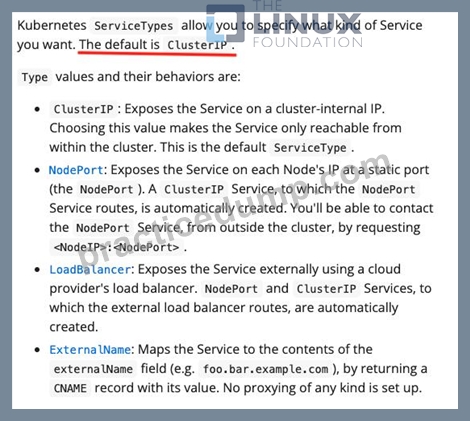
NEW QUESTION # 147
Which of the following statements is correct concerning Open Policy Agent (OPA)?
- A. It cannot be used outside Kubernetes.
- B. Kubernetes can use it to validate requests and apply policies.
- C. The policies must be written in Python language.
- D. Policies can only be tested when published.
Answer: B
Explanation:
Open Policy Agent (OPA) is a general-purpose policy engine used to define and enforce policy across different systems. In Kubernetes, OPA is commonly integrated through admission control (often via Gatekeeper or custom admission webhooks) to validate and/or mutate requests before they are persisted in the cluster. This makes B correct: Kubernetes can use OPA to validate API requests and apply policy decisions.
Kubernetes' admission chain is where policy enforcement naturally fits. When a user or controller submits a request (for example, to create a Pod), the API server can call external admission webhooks. Those webhooks can evaluate the request against policy-such as "no privileged containers," "images must come from approved registries," "labels must include cost-center," or "Ingress must enforce TLS." OPA's policy language (Rego) allows expressing these rules in a declarative form, and the decision ("allow/deny" and sometimes patches) is returned to the API server. This enforces governance consistently and centrally.
Option A is incorrect because OPA policies are written in Rego, not Python. Option C is incorrect because policies can be tested locally and in CI pipelines before deployment; in fact, testability is a key advantage.
Option D is incorrect because OPA is designed to be platform-agnostic-it can be used with APIs, microservices, CI/CD pipelines, service meshes, and infrastructure tools, not only Kubernetes.
From a Kubernetes fundamentals view, OPA complements RBAC: RBAC answers "who can do what to which resources," while OPA-style admission policies answer "even if you can create this resource, does it meet our organizational rules?" Together they help implement defense in depth: authentication + authorization + policy admission + runtime security controls. That is why OPA is widely used to enforce security and compliance requirements in Kubernetes environments.
=========
NEW QUESTION # 148
Which of the following workload requires a headless Service while deploying into the namespace?
- A. DaemonSet
- B. CronJob
- C. StatefulSet
- D. Deployment
Answer: C
Explanation:
A StatefulSet commonly requires a headless Service, so A is the correct answer. In Kubernetes, StatefulSets are designed for workloads that need stable identities, stable network names, and often stable storage per replica. To support that stable identity model, Kubernetes typically uses a headless Service (spec.clusterIP:
None) to provide DNS records that map directly to each Pod, rather than load-balancing behind a single virtual ClusterIP.
With a headless Service, DNS queries return individual endpoint records (the Pod IPs) so that each StatefulSet Pod can be addressed predictably, such as pod-0.service-name.namespace.svc.cluster.local. This is critical for clustered databases, quorum systems, and leader/follower setups where members must discover and address specific peers. The StatefulSet controller then ensures ordered creation/deletion and preserves identity (pod-0, pod-1, etc.), while the headless Service provides discovery for those stable hostnames.
CronJobs run periodic Jobs and don't require stable DNS identity for multiple replicas. Deployments manage stateless replicas and normally use a standard Service that load-balances across Pods. DaemonSets run one Pod per node, and while they can be exposed by Services, they do not intrinsically require headless discovery.
So while you can use a headless Service for other designs, StatefulSet is the workload type most associated with "requires a headless Service" due to how stable identities and per-Pod addressing work in Kubernetes.
NEW QUESTION # 149
You are implementing a GitOps workflow for your Kubernetes cluster. Which of the following best practices should you consider?
- A. IJse a separate Git repository for each Kubernetes resource, such as deployments, services, and ingress.
- B. Store all your Kubernetes configurations in a single Git repository, regardless of their purpose or scope.
- C. IJse Git tags to mark specific releases of your Kubernetes configurations.
- D. Ensure that all changes to your Kubernetes configurations are reviewed and approved before being deployed.
- E. Organize your Git repository with a clear directory structure for different namespaces and applications.
Answer: C,D,E
Explanation:
Option C promotes organization and maintainability by structuring your repository, while option D enables tracking specific releases through Git tags. Option E emphasizes the importance of code reviews and approvals to ensure the integrity of your deployments. These practices collectively contribute to a robust and well-managed GitOps workflow.
NEW QUESTION # 150
Can a Kubernetes Service expose multiple ports?
- A. No, you can only expose one port per each Service.
- B. Yes, the only requirement is to use different port numbers.
- C. No, because the only port you can expose is port number 443.
- D. Yes, but you must specify an unambiguous name for each port.
Answer: D
Explanation:
Yes, a Kubernetes Service can expose multiple ports, and when it does, each port should have a unique, unambiguous name, making B correct. In the Service spec, the ports field is an array, allowing you to define multiple port mappings (e.g., 80 for HTTP and 443 for HTTPS, or grpc and metrics). Each entry can include port (Service port), targetPort (backend Pod port), and protocol.
The naming requirement becomes important because Kubernetes needs to disambiguate ports, especially when other resources refer to them. For example, an Ingress backend or some proxies/controllers can reference Service ports by name. Also, when multiple ports exist, a name helps humans and automation reliably select the correct port. Kubernetes documentation and common practice recommend naming ports whenever there is more than one, and in several scenarios it's effectively required to avoid ambiguity.
Option A is incorrect because multi-port Services are common and fully supported. Option C is insufficient: while different port numbers are necessary, naming is the correct distinguishing rule emphasized by Kubernetes patterns and required by some integrations. Option D is incorrect and nonsensical-Services can expose many ports and are not restricted to 443.
Operationally, exposing multiple ports through one Service is useful when a single backend workload provides multiple interfaces (e.g., application traffic and a metrics endpoint). You can keep stable discovery under one DNS name while still differentiating ports. The backend Pods must still listen on the target ports, and selectors determine which Pods are endpoints. The key correctness point for this question is: multi-port Services are allowed, and each port should be uniquely named to avoid confusion and integration issues.
NEW QUESTION # 151
Which statement best describes the role of kubelet on a Kubernetes worker node?
- A. kubelet acts as the primary API component that stores and manages cluster state information.
- B. kubelet monitors cluster-wide resource usage and assigns Pods to the most suitable nodes for execution.
- C. kubelet manages the container runtime and ensures that all Pods scheduled to the node are running as expected.
- D. kubelet configures networking rules on each node to handle traffic routing for Services in the cluster.
Answer: C
Explanation:
The kubelet is the primary node-level agent in Kubernetes and is responsible for ensuring that workloads assigned to a worker node are executed correctly. Its core function is to manage container execution on the node and ensure that all Pods scheduled to that node are running as expected, which makes option A the correct answer.
Once the Kubernetes scheduler assigns a Pod to a node, the kubelet on that node takes over responsibility for running the Pod. It continuously watches the API server for Pod specifications that target its node and then interacts with the container runtime (such as containerd or CRI-O) through the Container Runtime Interface (CRI). The kubelet starts, stops, and restarts containers to match the desired state defined in the Pod specification.
In addition to lifecycle management, the kubelet performs ongoing health monitoring. It executes liveness, readiness, and startup probes, reports Pod and node status back to the API server, and enforces resource limits defined in the Pod specification. If a container crashes or becomes unhealthy, the kubelet initiates recovery actions such as restarting the container.
Option B is incorrect because configuring Service traffic routing is the responsibility of kube-proxy and the cluster's networking layer, not the kubelet. Option C is incorrect because cluster-wide resource monitoring and Pod placement decisions are handled by the kube-scheduler. Option D is incorrect because cluster state is managed by the API server and stored in etcd, not by the kubelet.
In summary, the kubelet acts as the executor and supervisor of Pods on each worker node. It bridges the Kubernetes control plane and the actual runtime environment, ensuring that containers are running, healthy, and aligned with the declared configuration. Therefore, Option A is the correct and verified answer.
NEW QUESTION # 152
Consider a pod with a "readinessProbe" that checks for a specific file existence. Explain what happens if the probe fails repeatedly, and how it affects the pod's lifecycle.
- A. The pod will be rescheduled to a different node in the cluster.
- B. The pod will be terminated and removed from the cluster.
- C. The pod will be automatically scaled down.
- D. The pod will be automatically restarted.
- E. The pod will be marked as "unhealthy", but will continue to run.
Answer: E
Explanation:
If the "readinessProbe" fails repeatedly, the pod will be marked as "unhealthy", but it will continue to run. The "readinessProbe" is responsible for ensuring that the pod is ready to receive traffic. If the probe fails, it indicates that the pod is not yet ready, and Kubernetes will not direct traffic to it. The pod will not be restarted, terminated, rescheduled, or scaled down. It will remain in an unhealthy state, and traffic will only be directed to it once the probe starts succeeding. This allows the pod to continue running while it resolves the issue causing the probe failures.
NEW QUESTION # 153
Let's assume that an organization needs to process large amounts of data in bursts, on a cloud-based Kubernetes cluster. For instance: each Monday morning, they need to run a batch of 1000 compute jobs of 1 hour each, and these jobs must be completed by Monday night. What's going to be the most cost-effective method?
- A. Commit to a specific level of spending to get discounted prices (with e.g. "reserved instances" or similar mechanisms).
- B. Leverage the Kubernetes Cluster Autoscaler to automatically start and stop nodes as they're needed.
- C. Use PriorityClasses so that the weekly batch job gets priority over other workloads running on the cluster, and can be completed on time.
- D. Run a group of nodes with the exact required size to complete the batch on time, and use a combination of taints, tolerations, and nodeSelectors to reserve these nodes to the batch jobs.
Answer: B
Explanation:
Burst workloads are a classic elasticity problem: you need large capacity for a short window, then very little capacity the rest of the week. The most cost-effective approach in a cloud-based Kubernetes environment is to scale infrastructure dynamically, matching node count to current demand. That's exactly what Cluster Autoscaler is designed for: it adds nodes when Pods cannot be scheduled due to insufficient resources and removes nodes when they become underutilized and can be drained safely. Therefore B is correct.
Option A can work operationally, but it commonly results in paying for a reserved "standing army" of nodes that sit idle most of the week-wasteful for bursty patterns unless the nodes are repurposed for other workloads. Taints/tolerations and nodeSelectors are placement tools; they don't reduce cost by themselves and may increase waste if they isolate nodes. Option D (PriorityClasses) affects which Pods get scheduled first given available capacity, but it does not create capacity. If the cluster doesn't have enough nodes, high priority Pods will still remain Pending. Option C (reserved instances or committed-use discounts) can reduce unit price, but it assumes relatively predictable baseline usage. For true bursts, you usually want a smaller baseline plus autoscaling, and optionally combine it with discounted capacity types if your cloud supports them.
In Kubernetes terms, the control loop is: batch Jobs create Pods # scheduler tries to place Pods # if many Pods are Pending due to insufficient CPU/memory, Cluster Autoscaler observes this and increases the node group size # new nodes join and kube-scheduler places Pods # after jobs finish and nodes become empty, Cluster Autoscaler drains and removes nodes. This matches cloud-native principles: elasticity, pay-for-what-you-use, and automation. It minimizes idle capacity while still meeting the completion deadline.
=========
NEW QUESTION # 154
Which of the following Kubernetes components is responsible for managing the lifecycle of Pods, including scheduling, creation, and deletion?
- A. kubectl
- B. amserver
- C. Controller Manager
- D. Kubelet
- E. etcd
Answer: C
Explanation:
The Kubernetes Controller Manager is responsible for managing the lifecycle of Pods. It monitors the state of Pods and ensures that they are running as intended. It also handles pod creation, deletion, and scaling based on the defined Deployment or ReplicaSet.
NEW QUESTION # 155
Imagine you're releasing open-source software for the first time. Which of the following is a valid semantic version?
- A. 2021-10-11
- B. v1beta1
- C. 1.0
- D. 0.1.0-rc
Answer: D
Explanation:
Semantic Versioning (SemVer) follows the pattern MAJOR.MINOR.PATCH with optional pre-release identifiers (e.g., -rc, -alpha.1) and build metadata. Among the options, 0.1.0-rc matches SemVer rules, so C is correct.
0.1.0-rc breaks down as: MAJOR=0, MINOR=1, PATCH=0, and -rc indicates a pre-release ("release candidate"). Pre-release versions are valid SemVer and are explicitly allowed to denote versions that are not yet considered stable. For a first-time open-source release, 0.x.y is common because it signals the API may still change in backward-incompatible ways before reaching 1.0.0.
Why the other options are not correct SemVer as written:
1.0 is missing the PATCH segment; SemVer requires three numeric components (e.g., 1.0.0).
2021-10-11 is a date string, not MAJOR.MINOR.PATCH.
v1beta1 resembles Kubernetes API versioning conventions, not SemVer.
In cloud-native delivery and Kubernetes ecosystems, SemVer matters because it communicates compatibility. Incrementing MAJOR indicates breaking changes, MINOR indicates backward-compatible feature additions, and PATCH indicates backward-compatible bug fixes. Pre-release tags allow releasing candidates for testing without claiming full stability. This is especially useful for open-source consumers and automation systems that need consistent version comparison and upgrade planning.
So, the only valid semantic version in the choices is 0.1.0-rc, option C.
NEW QUESTION # 156
How does service logical group set of pods?
- A. Using label and selectors
- B. Using IP address
- C. Using hostname
Answer: A
Explanation:
https://kubernetes.io/docs/concepts/services-networking/service/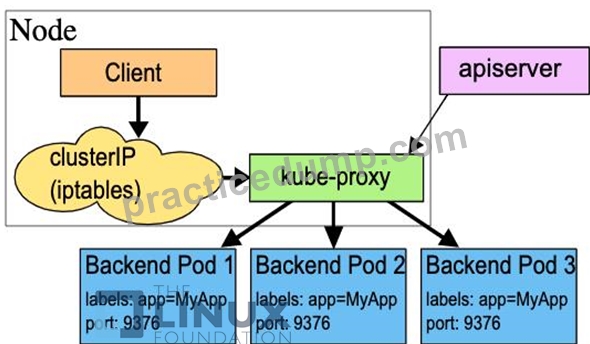
NEW QUESTION # 157
How is application data maintained in containers?
- A. Store data in separate folders.
- B. Store data into sidecar containers.
- C. Store data into volumes.
- D. Store data into data folders.
Answer: C
Explanation:
Container filesystems are ephemeral: the writable layer is tied to the container lifecycle and can be lost when containers are recreated. Therefore, maintaining application data correctly means storing it in volumes, making D the correct answer. In Kubernetes, volumes provide durable or shareable storage that is mounted into containers at specific paths. Depending on the volume type, the data can persist across container restarts and even Pod rescheduling.
Kubernetes supports many volume patterns. For transient scratch data you might use emptyDir (ephemeral for the Pod's lifetime). For durable state, you typically use PersistentVolumes consumed by PersistentVolumeClaims (PVCs), backed by storage systems via CSI drivers (cloud disks, SAN/NAS, distributed storage). This decouples the application container image from its state and enables rolling updates, rescheduling, and scaling without losing data.
Options A and B ("folders") are incomplete because folders inside the container filesystem do not guarantee persistence. A folder is only as durable as the underlying storage; without a mounted volume, it lives in the container's writable layer and will disappear when the container is replaced. Option C is incorrect because "sidecar containers" are not a data durability mechanism; sidecars can help ship logs or sync data, but persistent data should still be stored on volumes (or external services like managed databases).
From an application delivery standpoint, the principle is: containers should be immutable and disposable, and state should be externalized. Volumes (and external managed services) make this possible. In Kubernetes, this is a foundational pattern enabling safe rollouts, self-healing, and portability: the platform can kill and recreate Pods freely because data is maintained independently via volumes.
Therefore, the verified correct choice is D: Store data into volumes.
NEW QUESTION # 158
......
Full KCNA Practice Test and 242 Unique Questions, Get it Now!: https://testking.practicedump.com/KCNA-exam-questions.html