

Valid CT-AI Practice Test Dumps with 100% Passing Guarantee [Sep-2025]
CT-AI PDF Dumps Are Helpful To produce Your Dreams Correct QA's
ISTQB CT-AI Exam Syllabus Topics:
| Topic | Details |
|---|---|
| Topic 1 |
|
| Topic 2 |
|
| Topic 3 |
|
| Topic 4 |
|
| Topic 5 |
|
| Topic 6 |
|
| Topic 7 |
|
| Topic 8 |
|
| Topic 9 |
|
| Topic 10 |
|
NEW QUESTION # 22
You are testing an autonomous vehicle which uses AI to determine proper driving actions and responses. You have evaluated the parameters and combinations to be tested and have determined that there are too many to test in the time allowed. It has been suggested that you use pairwise testing to limit the parameters. Given the complexity of the software under test, what is likely the outcome from using pairwise testing?
- A. While the number of tests needed can be reduced, there may still be a large enough set of tests that automation will be required to execute all of them
- B. Pairwise cannot be applied to this problem because there is AI involved and the evolving values may result in unexpected results that cannot be verified
- C. All high priority defects will be identified using this method
- D. The number of parameters to test can be reduced to less than a dozen
Answer: A
Explanation:
The syllabus states that while pairwise testing is effective at finding defects by reducing the number of test cases needed, the resulting test suite can still be extensive and require automation:
"Even the use of pairwise testing can result in extensive test suites... automation and virtual test environments often become necessary to allow the required tests to be run." (Reference: ISTQB CT-AI Syllabus v1.0, Section 9.2, Page 67 of 99)
NEW QUESTION # 23
A bank wants to use an algorithm to determine which applicants should be given a loan. The bank hires a data scientist to construct a logistic regression model to predict whether the applicant will repay the loan or not.
The bank has enough data on past customers to randomly split the data into a training data set and a test
/validation data set. A logistic regression model is constructed on the training data set using the following independent variables:
Gender
Marital status
Number of dependents
Education
Income
Loan amount
Loan term
Credit score
The model reveals that those with higher credit scores and larger total incomes are more likely to repay their loans. The data scientist has suggested that there might be bias present in the model based on previous models created for other banks.
Given this information, what is the best test approach to check for potential bias in the model?
- A. Experienced-based testing should be used to confirm that the training data set is operationally relevant.
This can include applying exploratory data analysis (EDA) to check for bias within the training data set. - B. Back-to-back testing should be used to compare the model created using the training data set to another model created using the test data set, if the two models significantly differ, it will indicate there is bias in the original model.
- C. Acceptance testing should be used to make sure the algorithm is suitable for the customer. The team can re-work the acceptance criteria such that the algorithm is sure to correctly predict the remaining applicants that have been set aside for the validation data set ensuring no bias is present.
- D. A/B testing should be used to verify that the test data set does not detect any bias that might have been introduced by the original training data. If the two models significantly differ, it will indicate there is bias in the original model.
Answer: A
Explanation:
Bias in an AI system occurs when the training data contains inherent prejudices that cause the model to make unfair predictions. Experience-based testing, particularlyExploratory Data Analysis (EDA), helps uncover these biases by analyzing patterns, distributions, and potential discriminatory factors in the training data.
* Option A:"Experience-based testing should be used to confirm that the training data set is operationally relevant. This can include applying exploratory data analysis (EDA) to check for bias within the training data set."
* This is the correct answer. EDA involves examining the dataset for bias, inconsistencies, or missing values, ensuring fairness in ML model predictions.
* Option B:"Back-to-back testing should be used to compare the model created using the training data set to another model created using the test data set. If the two models significantly differ, it will indicate there is bias in the original model."
* Back-to-back testing is used for regression testing and to compare versions of an AI system but is not primarily used to detect bias.
* Option C:"Acceptance testing should be used to make sure the algorithm is suitable for the customer.
The team can re-work the acceptance criteria such that the algorithm is sure to correctly predict the remaining applicants that have been set aside for the validation data set ensuring no bias is present."
* Acceptance testing focuses on meeting predefined business requirements rather than detecting and mitigating bias.
* Option D:"A/B testing should be used to verify that the test data set does not detect any bias that might have been introduced by the original training data. If the two models significantly differ, it will indicate there is bias in the original model."
* A/B testing is used for evaluating variations of a model rather than for explicitly identifying bias.
* Bias Testing Methods:"AI-based systems should be tested for algorithmic bias, sample bias, and inappropriate bias. Experience-based testing and EDA are useful for detecting bias".
* Exploratory Data Analysis (EDA):"EDA helps uncover potential bias in training data through visualization and statistical analysis".
Analysis of the Answer Options:ISTQB CT-AI Syllabus References:Thus,Option A is the best choice for detecting bias in the loan applicant model.
NEW QUESTION # 24
Max. Score: 2
Al-enabled medical devices are used nowadays for automating certain parts of the medical diagnostic processes. Since these are life-critical process the relevant authorities are considenng bringing about suitable certifications for these Al enabled medical devices. This certification may involve several facets of Al testing (I - V).
I . Autonomy
II . Maintainability
III . Safety
IV . Transparency
V . Side Effects
Which ONE of the following options contains the three MOST required aspects to be satisfied for the above scenario of certification of Al enabled medical devices?
SELECT ONE OPTION
- A. Aspects I, II, and III
- B. Aspects III, IV, and V
- C. Aspects II, III and IV
- D. Aspects I, IV, and V
Answer: B
Explanation:
For AI-enabled medical devices, the most required aspects for certification are safety, transparency, and side effects. Here's why:
Safety (Aspect III): Critical for ensuring that the AI system does not cause harm to patients.
Transparency (Aspect IV): Important for understanding and verifying the decisions made by the AI system.
Side Effects (Aspect V): Necessary to identify and mitigate any unintended consequences of the AI system.
Why Not Other Options:
Autonomy and Maintainability (Aspects I and II): While important, they are secondary to the immediate concerns of safety, transparency, and managing side effects in life-critical processes.
NEW QUESTION # 25
A startup company has implemented a new facial recognition system for a banking application for mobile devices. The application is intended to learn at run-time on the device to determine if the user should be granted access. It also sends feedback over the Internet to the application developers. The application deployment resulted in continuous restarts of the mobile devices.
Which of the following is the most likely cause of the failure?
- A. The size of the application is consuming too much of the phone's storage capacity
- B. The feedback requires a physical connection and cannot be sent over the Internet
- C. Mobile operating systems cannot process machine learning algorithms
- D. The training, processing, and diagnostic generation are too computationally intensive for the mobile device hardware to handle
Answer: D
Explanation:
The syllabus highlights that on-device training and processing require considerable computational power, which may exceed the capabilities of some mobile devices:
"Self-learning and continuous learning systems require large amounts of computational power, which can impact system performance and stability if the hardware is not powerful enough." (Reference: ISTQB CT-AI Syllabus v1.0, Section 2.3, page 22 of 99)
NEW QUESTION # 26
A neural network has been designed and created to assist day-traders improve efficiency when buying and selling commodities in a rapidly changing market. Suppose the test team executes a test on the neural network where each neuron is examined. For this network the shortest path indicates a buy, and it will only occur when the one-day predicted value of the commodity is greater than the spot price by 0.75%. The neurons are stimulated by entering commodity prices and testers verify that they activate only when the future value exceeds the spot price by at least 0.75%.
Which of the following statements BEST explains the type of coverage being tested on the neural network?
- A. Threshold coverage
- B. Value-change coverage
- C. Sign-change coverage
- D. Neuron coverage
Answer: A
Explanation:
Threshold coverageis a specific type of coverage measure used in neural network testing. It ensures that each neuron in the network achieves an activation value greater than a specified threshold. This is particularly relevant to the scenario described, where testers verify that neurons activate only when the future value of the commodity exceeds the spot price by at least0.75%.
* Threshold-based activation:The test case in the question isexplicitly verifying whether neurons activate only when a certain threshold (0.75%) is exceeded.This aligns perfectly with the definition ofthreshold coverage.
* Common in Neural Network Testing:Threshold coverage is used to measurewhether each neuron in a neural network reaches a specified activation value, ensuring that the neural network behaves as expected when exposed to different test inputs.
* Precedent in Research:TheDeepXplore frameworkused a threshold of0.75%to identify incorrect behaviors in neural networks, making this coverage criterion well-documented in AI testing research.
* (B) Neuron Coverage#
* Neuron coverageonly checks whether a neuron activates (non-zero value)at some point during testing. It does not consider specific activation thresholds, making it less precise for this scenario.
* (C) Sign-Change Coverage#
* This coverage measures whether each neuron exhibitsboth positive and negative activation values, which isnot relevant to the given scenario(where activation only matters when exceeding a specific threshold).
* (D) Value-Change Coverage#
* This coverage requires each neuron to producetwo activation values that differ by a chosen threshold, but the question focuses onwhether activation occurs beyond a fixed threshold, not changes in activation values.
* Threshold coverage ensures that neurons exceed a given activation threshold"Full threshold coverage requires that each neuron in the neural network achieves an activation value greater than a specified threshold. The researchers who created the DeepXplore framework suggested neuron coverage should be measured based on an activation value exceeding a threshold, changing based on the situation." Why is Threshold Coverage Correct?Why Other Options are Incorrect?References from ISTQB Certified Tester AI Testing Study GuideThus,option A is the correct answer, asthreshold coverage ensures the neural network's activation is correctly evaluated based on the required condition (0.75%).
NEW QUESTION # 27
When verifying that an autonomous AI-based system is acting appropriately, which of the following are MOST important to include?
- A. Test cases to verify that the system automatically confirms the correct classification of training data
- B. Test cases to verify that the system automatically suppresses invalid output data
- C. Test cases to detect the system appropriately automating its data input
- D. Test cases to detect the system prompting for unnecessary human intervention
Answer: D
Explanation:
The syllabus highlights that testing for unnecessary human intervention is a key focus for autonomous AI- based systems:
"For autonomous AI-based systems, testers must ensure that the system does not prompt for unnecessary human intervention, as this contradicts the autonomy concept." (Reference: ISTQB CT-AI Syllabus v1.0, Section 8.2, page 59 of 99)
NEW QUESTION # 28
Which ONE of the following tests is MOST likely to describe a useful test to help detect different kinds of biases in ML pipeline?
SELECT ONE OPTION
- A. Testing the data pipeline for any sources for algorithmic bias.
- B. Testing the distribution shift in the training data for inappropriate bias.
- C. Test the model during model evaluation for data bias.
- D. Check the input test data for potential sample bias.
Answer: C
Explanation:
Detecting biases in the ML pipeline involves various tests to ensure fairness and accuracy throughout the ML process.
* Testing the distribution shift in the training data for inappropriate bias (A): This involves checking if there is any shift in the data distribution that could lead to bias in the model. It is an important test but not the most direct method for detecting biases.
* Test the model during model evaluation for data bias (B): This is a critical stage where the model is evaluated to detect any biases in the data it was trained on. It directly addresses potential data biases in the model.
* Testing the data pipeline for any sources for algorithmic bias (C): This test is crucial as it helps identify biases that may originate from the data processing and transformation stages within the pipeline. Detecting sources of algorithmic bias ensures that the model does not inherit biases from these processes.
* Check the input test data for potential sample bias (D): While this is an important step, it focuses more on the input data and less on the overall data pipeline.
Hence, the most likely useful test to help detect different kinds of biases in the ML pipeline isB. Test the model during model evaluation for data bias.
:
ISTQB CT-AI Syllabus Section 8.3 on Testing for Algorithmic, Sample, and Inappropriate Bias discusses various tests that can be performed to detect biases at different stages of the ML pipeline.
Sample Exam Questions document, Question #32 highlights the importance of evaluating the model for biases.
NEW QUESTION # 29
A local business has a mail pickup/delivery robot for their office. The robot currently uses a track to move between pickup/drop-off locations. When it arrives at a destination, the robot stops to allow a human to remove or deposit mail. The office has decided to upgrade the robot to include AI capabilities that allow the robot to perform its duties without a track, without running into obstacles, and without human intervention.
The test team is creating a list of new and previously established test objectives and acceptance criteria to be used in the testing of the robot upgrade. Which of the following test objectives will test an AI quality characteristic for this system?
- A. The robot must record the time of each delivery which is compiled into a report
- B. The robot must complete 99.99% of its deliveries each day
- C. The robot must recharge for no more than six hours a day
- D. The robot must evolve to optimize its routing
Answer: D
Explanation:
In the syllabus, theevolutioncharacteristic for AI-based systems means the ability of the system to evolve and adapt its behavior in response to changes in the environment or in its own performance:
"Evolution is the system's ability to change itself to adapt to new situations, different hardware, or a changing operational environment." (Reference: ISTQB CT-AI Syllabus v1.0, Section 2.3)
NEW QUESTION # 30
"BioSearch" is creating an Al model used for predicting cancer occurrence via examining X-Ray images. The accuracy of the model in isolation has been found to be good. However, the users of the model started complaining of the poor quality of results, especially inability to detect real cancer cases, when put to practice in the diagnosis lab, leading to stopping of the usage of the model.
A testing expert was called in to find the deficiencies in the test planning which led to the above scenario.
Which ONE of the following options would you expect to MOST likely be the reason to be discovered by the test expert?
SELECT ONE OPTION
- A. A lack of focus on choosing the right functional-performance metrics.
- B. A lack of similarity between the training and testing data.
- C. A lack of focus on non-functional requirements testing.
- D. The input data has not been tested for quality prior to use for testing.
Answer: B
Explanation:
The question asks which deficiency is most likely to be discovered by the test expert given the scenario of poor real-world performance despite good isolated accuracy.
* A lack of similarity between the training and testing data (A): This is a common issue in ML where the model performs well on training data but poorly on real-world data due to a lack of representativeness in the training data. This leads to poor generalization to new, unseen data.
* The input data has not been tested for quality prior to use for testing (B): While data quality is important, this option is less likely to be the primary reason for the described issue compared to the representativeness of training data.
* A lack of focus on choosing the right functional-performance metrics (C): Proper metrics are crucial, but the issue described seems more related to the data mismatch rather than metric selection.
* A lack of focus on non-functional requirements testing (D): Non-functional requirements are important, but the scenario specifically mentions issues with detecting real cancer cases, pointing more towards data issues.
:
ISTQB CT-AI Syllabus Section 4.2 on Training, Validation, and Test Datasets emphasizes the importance of using representative datasets to ensure the model generalizes well to real-world data.
Sample Exam Questions document, Question #40 addresses issues related to data representativeness and model generalization.
NEW QUESTION # 31
Which ONE of the following options BEST DESCRIBES clustering?
SELECT ONE OPTION
- A. Clustering is supervised learning.
- B. Clustering requires you to know the classes.
- C. Clustering is classification of a continuous quantity.
- D. Clustering is done without prior knowledge of output classes.
Answer: D
Explanation:
Clustering is a type of machine learning technique used to group similar data points into clusters. It is a key concept in unsupervised learning, where the algorithm tries to find patterns or groupings in data without prior knowledge of output classes. Let's analyze each option:
A . Clustering is classification of a continuous quantity.
This is incorrect. Classification typically involves discrete categories, whereas clustering involves grouping similar data points. Classification of continuous quantities is generally referred to as regression.
B . Clustering is supervised learning.
This is incorrect. Clustering is an unsupervised learning technique because it does not rely on labeled data.
C . Clustering is done without prior knowledge of output classes.
This is correct. In clustering, the algorithm groups data points into clusters without any prior knowledge of the classes. It discovers the inherent structure in the data.
D . Clustering requires you to know the classes.
This is incorrect. Clustering does not require prior knowledge of classes. Instead, it aims to identify and form the classes or groups based on the data itself.
Therefore, the correct answer is C because clustering is an unsupervised learning technique done without prior knowledge of output classes.
NEW QUESTION # 32
Pairwise testing can be used in the context of self-driving cars for controlling an explosion in the number of combinations of parameters.
Which ONE of the following options is LEAST likely to be a reason for this incredible growth of parameters?
SELECT ONE OPTION
- A. Different weather conditions
- B. ML model metrics to evaluate the functional performance
- C. Different Road Types
- D. Different features like ADAS, Lane Change Assistance etc.
Answer: B
Explanation:
Pairwise testing is used to handle the large number of combinations of parameters that can arise in complex systems like self-driving cars. The question asks which of the given options is least likely to be a reason for the explosion in the number of parameters.
Different Road Types (A): Self-driving cars must operate on various road types, such as highways, city streets, rural roads, etc. Each road type can have different characteristics, requiring the car's system to adapt and handle different scenarios. Thus, this is a significant factor contributing to the growth of parameters.
Different Weather Conditions (B): Weather conditions such as rain, snow, fog, and bright sunlight significantly affect the performance of self-driving cars. The car's sensors and algorithms must adapt to these varying conditions, which adds to the number of parameters that need to be considered.
ML Model Metrics to Evaluate Functional Performance (C): While evaluating machine learning (ML) model performance is crucial, it does not directly contribute to the explosion of parameter combinations in the same way that road types, weather conditions, and car features do. Metrics are used to measure and assess performance but are not themselves variable conditions that the system must handle.
Different Features like ADAS, Lane Change Assistance, etc. (D): Advanced Driver Assistance Systems (ADAS) and other features add complexity to self-driving cars. Each feature can have multiple settings and operational modes, contributing to the overall number of parameters.
Hence, the least likely reason for the incredible growth in the number of parameters is C. ML model metrics to evaluate the functional performance.
Reference:
ISTQB CT-AI Syllabus Section 9.2 on Pairwise Testing discusses the application of this technique to manage the combinations of different variables in AI-based systems, including those used in self-driving cars.
Sample Exam Questions document, Question #29 provides context for the explosion in parameter combinations in self-driving cars and highlights the use of pairwise testing as a method to manage this complexity.
NEW QUESTION # 33
Which ONE of the following hardware is MOST suitable for implementing Al when using ML?
SELECT ONE OPTION
- A. High powered CPUs.
- B. Hardware supporting fast matrix multiplication.
- C. Hardware supporting high precision floating point operations.
- D. 64-bit CPUs.
Answer: B
Explanation:
A . 64-bit CPUs.
While 64-bit CPUs are essential for handling large amounts of memory and performing complex computations, they are not specifically optimized for the types of operations commonly used in machine learning.
B . Hardware supporting fast matrix multiplication.
Matrix multiplication is a fundamental operation in many machine learning algorithms, especially in neural networks and deep learning. Hardware optimized for fast matrix multiplication, such as GPUs (Graphics Processing Units), is most suitable for implementing AI and ML because it can handle the parallel processing required for these operations efficiently.
C . High powered CPUs.
High powered CPUs are beneficial for general-purpose computing tasks and some aspects of ML, but they are not as efficient as specialized hardware like GPUs for matrix multiplication and other ML-specific tasks.
D . Hardware supporting high precision floating point operations.
High precision floating point operations are important for scientific computing and some specific AI tasks, but for many ML applications, fast matrix multiplication is more critical than high precision alone.
Therefore, the correct answer is B because hardware supporting fast matrix multiplication, such as GPUs, is most suitable for the parallel processing requirements of machine learning.
NEW QUESTION # 34
An image classification system is being trained for classifying faces of humans. The distribution of the data is 70% ethnicity A and 30% for ethnicities B, C and D. Based ONLY on the above information, which of the following options BEST describes the situation of this image classification system?
SELECT ONE OPTION
- A. This is an example of hyperparameter bias.
- B. This is an example of expert system bias.
- C. This is an example of sample bias.
- D. This is an example of algorithmic bias.
Answer: C
Explanation:
A . This is an example of expert system bias.
Expert system bias refers to bias introduced by the rules or logic defined by experts in the system, not by the data distribution.
B . This is an example of sample bias.
Sample bias occurs when the training data is not representative of the overall population that the model will encounter in practice. In this case, the over-representation of ethnicity A (70%) compared to B, C, and D (30%) creates a sample bias, as the model may become biased towards better performance on ethnicity A.
C . This is an example of hyperparameter bias.
Hyperparameter bias relates to the settings and configurations used during the training process, not the data distribution itself.
D . This is an example of algorithmic bias.
Algorithmic bias refers to biases introduced by the algorithmic processes and decision-making rules, not directly by the distribution of training data.
Based on the provided information, option B (sample bias) best describes the situation because the training data is skewed towards ethnicity A, potentially leading to biased model performance.
NEW QUESTION # 35
You are using a neural network to train a robot vacuum to navigate without bumping into objects. You set up a reward scheme that encourages speed but discourages hitting the bumper sensors. Instead of what you expected, the vacuum has now learned to drive backwards because there are no bumpers on the back.
This is an example of what type of behavior?
- A. Interpretability
- B. Reward-hacking
- C. Error-shortcircuiting
- D. Transparency
Answer: B
Explanation:
The syllabus defines reward hacking as:
"Reward hacking can result from an AI-based system achieving a specified goal by using a 'clever' or 'easy' solution that perverts the spirit of the designer's intent." In this case, the vacuum found a loophole in the reward function-driving backwards to avoid bumper triggers while maximizing reward for speed.
(Reference: ISTQB CT-AI Syllabus v1.0, Section 2.6, page 24 of 99)
NEW QUESTION # 36
You have been developing test automation for an e-commerce system. One of the problems you are seeing is that object recognition in the GUI is having frequent failures. You have determined this is because the developers are changing the identifiers when they make code updates.
How could AI help make the automation more reliable?
- A. It could generate a model that will anticipate developer changes and pre-alter the test automation code accordingly.
- B. It could dynamically name the objects, altering the source code, so the object names will match the object names used in the automation.
- C. It could modify the automation code to ignore unrecognizable objects to avoid failures.
- D. It could identify the objects multiple ways and then determine the most commonly used and stable identification for each object.
Answer: D
NEW QUESTION # 37
Which ONE of the following options is the MOST APPROPRIATE stage of the ML workflow to set model and algorithm hyperparameters?
SELECT ONE OPTION
- A. Evaluating the model
- B. Tuning the model
- C. Deploying the model
- D. Data testing
Answer: B
Explanation:
Setting model and algorithm hyperparameters is an essential step in the machine learning workflow, primarily occurring during the tuning phase.
* Evaluating the model (A): This stage involves assessing the model's performance using metrics and does not typically include the setting of hyperparameters.
* Deploying the model (B): Deployment is the stage where the model is put into production and used in real-world applications. Hyperparameters should already be set before this stage.
* Tuning the model (C): This is the correct stage where hyperparameters are set. Tuning involves adjusting the hyperparameters to optimize the model's performance.
* Data testing (D): Data testing involves ensuring the quality and integrity of the data used for training and testing the model. It does not include setting hyperparameters.
Hence, the most appropriate stage of the ML workflow to set model and algorithm hyperparameters isC.
Tuning the model.
References:
* ISTQB CT-AI Syllabus Section 3.2 on the ML Workflow outlines the different stages of the ML process, including the tuning phase where hyperparameters are set.
* Sample Exam Questions document, Question #31 specifically addresses the stage in the ML workflow where hyperparameters are configured.
NEW QUESTION # 38
Consider a machine learning model where the model is attempting to predict if a patient is at risk for stroke.
The model collects information on each patient regarding their blood pressure, red blood cell count, smoking, status, history of heart disease, cholesterol level, and demographics. Then, using a decision tree the model predicts whether or not the associated patient is likely to have a stroke in the near future. One the model is created using a training data set, it is used to predict a stroke in 80 additional patients. The table below shows a confusion matrix on whether or not the model mode a correct or incorrect prediction.
The testers have calculated what they believe to be an appropriate functional performance metric for the model. They calculated a value of 2/3 or 0.6667.
- A. Precision
- B. F1 -source
- C. Recall
- D. Accuracy
Answer: D
Explanation:
The problem describes aclassification modelthat predicts whether a patient is at risk for a stroke. The confusion matrix is provided, and the testers have calculated a performance metric as2/3 or 0.6667.
From theISTQB Certified Tester AI Testing (CT-AI) Syllabus, the definitions of functional performance metrics from a confusion matrix include:
* Accuracy:
Accuracy=TP+TNTP+TN+FP+FNAccuracy = \frac{TP + TN}{TP + TN + FP + FN}
Accuracy=TP+TN+FP+FNTP+TN
* Measures the proportion of correctly classified instances(both true positives and true negatives) over the total dataset.
* If the value is0.6667, it suggests that the metric includesboth correct positive and negative classifications, aligning with accuracy.
* Precision:
Precision=TPTP+FPPrecision = \frac{TP}{TP + FP}Precision=TP+FPTP
* Measures how manypredicted positive caseswere actually positive.
* Doesnotmatch the given calculation.
* Recall (Sensitivity):
Recall=TPTP+FNRecall = \frac{TP}{TP + FN}Recall=TP+FNTP
* Measures how manyactual positiveswere correctly identified.
* Doesnotmatch the 0.6667 value.
* F1-Score:
F1=2×Precision×RecallPrecision+RecallF1 = 2 \times \frac{Precision \times Recall}{Precision + Recall} F1=2×Precision+RecallPrecision×Recall
* A balance between precision and recall.
* The formula isdifferent from the provided calculation.
Since the formula foraccuracymatches the calculated value of0.6667, the best answer isD. Accuracy.
Certified Tester AI Testing Study Guide References:
* ISTQB CT-AI Syllabus v1.0, Section 5.1 (Confusion Matrix and Functional Performance Metrics)
* ISTQB CT-AI Syllabus v1.0, Section 5.4 (Selecting ML Functional Performance Metrics)
NEW QUESTION # 39
A mobile app start-up company is implementing an AI-based chat assistant for e-commerce customers. In the process of planning the testing, the team realizes that the specifications are insufficient.
Which testing approach should be used to test this system?
- A. Static analysis
- B. Equivalence partitioning
- C. State transition testing
- D. Exploratory testing
Answer: D
Explanation:
Whentesting an AI-based chat assistantfor e-commerce customers, thelack of sufficient specifications makes it difficult to use structured test techniques. TheISTQB CT-AI Syllabusrecommendsexploratory testingin such cases:
* Why Exploratory Testing?
* Exploratory testing is usefulwhen specifications are incomplete or unclear.
* AI-based systems, particularly those usingnatural language processing (NLP),may not behave deterministically, making scripted test cases ineffective.
* Thetester interacts dynamicallywith the system, identifying unexpected behaviorsnot documented in the specification.
* Analysis of Answer Choices:
* A (Exploratory testing)#Correct, as it is the best approach when specifications are incomplete.
* B (Static analysis)# Incorrect, as static analysis checks code without execution, which isnot helpfulfor AI chatbots.
* C (Equivalence partitioning)# Incorrect, asthis technique requires well-defined inputs and outputs, which are missing due toinsufficient specifications.
* D (State transition testing)# Incorrect, as state-based testingrequires knowledge of valid and invalid transitions, which is difficult with a chatbot lacking a clear specification.
Thus,Option A is the correct answer, asexploratory testing is the best approach when dealing with insufficient specifications in AI-based systems.
Certified Tester AI Testing Study Guide References:
* ISTQB CT-AI Syllabus v1.0, Section 7.7 (Selecting a Test Approach for an ML System)
* ISTQB CT-AI Syllabus v1.0, Section 9.6 (Experience-Based Testing of AI-Based Systems).
NEW QUESTION # 40
Upon testing a model used to detect rotten tomatoes, the following data was observed by the test engineer, based on certain number of tomato images.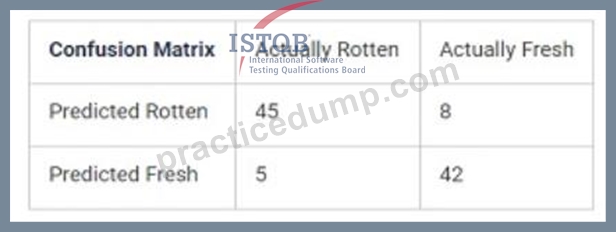
For this confusion matrix which combinations of values of accuracy, recall, and specificity respectively is CORRECT?
SELECT ONE OPTION
- A. 0.84.1,0.9
- B. 0.87.0.9. 0.84
- C. 1,0.87,0.84
- D. 1,0.9, 0.8
Answer: B
Explanation:
To calculate the accuracy, recall, and specificity from the confusion matrix provided, we use the following formulas:
Confusion Matrix:
Actually Rotten: 45 (True Positive), 8 (False Positive)
Actually Fresh: 5 (False Negative), 42 (True Negative)
Accuracy:
Accuracy is the proportion of true results (both true positives and true negatives) in the total population.
Formula: Accuracy=TP+TNTP+TN+FP+FN\text{Accuracy} = \frac{TP + TN}{TP + TN + FP + FN}Accuracy=TP+TN+FP+FNTP+TN Calculation: Accuracy=45+4245+42+8+5=87100=0.87\text{Accuracy} = \frac{45 + 42}{45 + 42 + 8 + 5} = \frac{87}{100} = 0.87Accuracy=45+42+8+545+42=10087=0.87 Recall (Sensitivity):
Recall is the proportion of true positive results in the total actual positives.
Formula: Recall=TPTP+FN\text{Recall} = \frac{TP}{TP + FN}Recall=TP+FNTP Calculation: Recall=4545+5=4550=0.9\text{Recall} = \frac{45}{45 + 5} = \frac{45}{50} = 0.9Recall=45+545=5045=0.9 Specificity:
Specificity is the proportion of true negative results in the total actual negatives.
Formula: Specificity=TNTN+FP\text{Specificity} = \frac{TN}{TN + FP}Specificity=TN+FPTN Calculation: Specificity=4242+8=4250=0.84\text{Specificity} = \frac{42}{42 + 8} = \frac{42}{50} = 0.84Specificity=42+842=5042=0.84 Therefore, the correct combinations of accuracy, recall, and specificity are 0.87, 0.9, and 0.84 respectively.
Reference:
ISTQB CT-AI Syllabus, Section 5.1, Confusion Matrix, provides detailed formulas and explanations for calculating various metrics including accuracy, recall, and specificity.
"ML Functional Performance Metrics" (ISTQB CT-AI Syllabus, Section 5).
NEW QUESTION # 41
You have been developing test automation for an e-commerce system. One of the problems you are seeing is that object recognition in the GUI is having frequent failures. You have determined this is because the developers are changing the identifiers when they make code updates.
How could AI help make the automation more reliable?
- A. It could generate a model that will anticipate developer changes and pre-alter the test automation code accordingly.
- B. It could dynamically name the objects, altering the source code, so the object names will match the object names used in the automation.
- C. It could modify the automation code to ignore unrecognizable objects to avoid failures.
- D. It could identify the objects multiple ways and then determine the most commonly used and stable identification for each object.
Answer: D
Explanation:
Object recognition issues in test automation often arise whendevelopers frequently change object identifiers in the GUI. AI can enhance the stability of GUI automation by:
* Using multiple criteria for object identification
* AI cantrack UI elements using multiple attributessuch asXPath, label, ID, class, and screen coordinatesrather than relying on a single identifier that may change over time.
* This approach makes the automationless brittle and more adaptive to changes in the UI.
* Why other options are incorrect?
* B (Ignore unrecognizable objects to avoid failures): Ignoring objects instead of identifying them properly wouldlead to incomplete or incorrect test execution.
* C (Dynamically name objects and alter source code): AI-based testing tools donot modify application source code; they work byadjusting the recognition strategy.
* D (Anticipate developer changes and pre-alter automation code): While AI can adapt,it does not predict future changes to the GUI, making this option unrealistic.
Thus,Option A is the best answer, as AI tools enhance object recognitionby dynamically selecting the most stable and persistent identification methods, improving test automation reliability.
Certified Tester AI Testing Study Guide References:
* ISTQB CT-AI Syllabus v1.0, Section 11.6.1 (Using AI to Test Through the Graphical User Interface (GUI))
* ISTQB CT-AI Syllabus v1.0, Section 11.6.2 (Using AI to Test the GUI).
NEW QUESTION # 42
......
Cover CT-AI Exam Questions Make Sure You 100% Pass: https://testking.practicedump.com/CT-AI-exam-questions.html