

Dec-2021 Realistic 8008 Exam Dumps with Accurate & Updated Questions
8008 Exam Dumps - PDF Questions and Testing Engine
NEW QUESTION 147
Which of the following describes rating transition matrices published by credit rating firms:
- A. Expected ex-ante frequencies of migration from one credit rating to another over a one year period
- B. Probabilities of ratings transition from one rating to another for a given set of issuers
- C. Realized frequencies of migration from one credit rating to another over a one year period
- D. Probabilities of default for each credit rating class
Answer: C
Explanation:
Explanation
Transition matrices are used for building distributions of the value of credit portfolios, and are the realized frequencies of migration from one credit rating to another over a period, generally one year. Therefore Choice
'd' is the correct answer.
Since they represent an actually observed set of values, they are not probabilities nor are they forward looking ex-ante estimates, though they are often used as proxies for probabilities. Choice 'a' and Choice 'c' are not correct. They include more than information on just defaults, therefore Choice 'b' is not correct.
NEW QUESTION 148
Loss provisioning is intended to cover:
- A. Expected losses
- B. Both expected and unexpected losses
- C. Unexpected losses
- D. Losses in excess of unexpected losses
Answer: A
Explanation:
Explanation
Loss provisioning is intended to cover expected losses. Economic capital is expected to cover unexpected losses. No capital or provisions are set aside for losses in excess of unexpected losses, which will ultimately be borne by equity.
Choice 'd' is the correct answer.
NEW QUESTION 149
Which of the following statements are true:
I. Credit risk and counterparty risk are synonymous
II. Counterparty risk is the contingent risk from a counterparty's default in derivative transactions III. Counterparty risk is the risk of a loan default or the risk from moneys lent directly IV. The exposure at default is difficult to estimate for credit risk as it depends upon market movements
- A. I and II
- B. II and III
- C. III and IV
- D. II
Answer: D
Explanation:
Explanation
Credit risk is the risk from a borrower defaulting on moneys lent. Counterparty risk, on the other hand, is the risk that a counterparty to a derivative transaction will be unable to pay at the time the transaction is in-the-money.
Credit risk therefore relates more to the banking book, counterparty risk relates more to the trading book.
Credit risk and counterparty risk differ in that for counterparty risk, the amount at risk fluctuates for counterparty risk depending upon the value of the underlying derivative. Counterparty risk generally starts at zero, for most swaps and other derivatives are near zero value at inception. Over time, as the prices of the underlying instruments move, one party ends up owing money to the other. A deterioration in the financial situation of the party owing moneys may lead to a loss to the other party, resulting in counterparty risk.
Counterparty risk can also arise from stock lending operations and repo trades.
Credit risk on the other hand is the traditional risk of default by a borrower, or a bank's customer who has taken a loan or has an overdraft or other credit facility.
Statement I is therefore incorrect as credit risk and counterparty risks are different.
Statement II is correct as counterparty risk is 'contingent' in the sense it arises only if the transaction with the counterparty ends up being in-the-money, and the counterparty defaults.
Statement III is incorrect. The statement describes credit risk.
Statement IV is incorrect, as the exposure is known for moneys lent. Derivative exposures for the future are difficult to estimate, they can even turn from moneys owed to moneys due as the value of the underlying changes.
NEW QUESTION 150
If the annual default hazard rate for a borrower is 10%, what is the probability that there is no default at the end of 5 years?
- A. 60.65%
- B. 50.00%
- C. 39.35%
- D. 59.05%
Answer: A
Explanation:
Explanation
A default hazard rate is the rate of default in a continuous time setting. This question is asking for probability of survival at the end of 5 years. The formula to calculate the probability of survival at the end of t years where the default hazard rate is is e^(- *t) (or in Excel, =exp(-*t). Therefore the correct answer is Choice 'd'.
(It may be tempting to infer that if the probability of survival at the end of 1 year is 90% (1 - 10%), then the probability of survival in 5 years would be 90%^5. However this reasoning is not correct for the reason that the given rate is not the discrete rate of default, but the hazard rate which is nothing but the continuously compounded rate of default.)
NEW QUESTION 151
The returns for a stock have a monthly volatilty of 5%. Calculate the volatility of the stock over a two month period, assuming returns between months have an autocorrelation of 0.3.
- A. 10%
- B. 5%
- C. 7.071%
- D. 8.062%
Answer: D
Explanation:
Explanation
The square root of time rule cannot be applied here because the returns across the periods are not independent.
(Recall that the square root of time rule requires returns to be iid, independent and identically distributed.) Here there is a 'autocorrelation' in play, which means one period's returns affect the returns of the other period.
This problem can be solved by combining the variance of the returns from the two consecutive periods in the same way as one would combine the variance of different assets that have a given correlation. In such cases we know that:
Variance (A + B) = Variance(A) + Variance(B) + 2*Correlation*StdDev(A)*StdDev(B).
The standard deviation can be calculated by taking the square root of the variance.
Therefore the combined volatility over the two months will be equal to =SQRT((5%^2) + (5%^2) +
2*0.3*5%*5%) = 8.062%. All other answers are incorrect.
NEW QUESTION 152
When considering a request for a loan from a retail customer, which of the following factors is relevant for a bank to consider:
- A. The contribution this new loan would bring to total portfolio risk
- B. All of the above
- C. The other retail loans in its portfolio
- D. The credit worthiness of the retail customer
Answer: B
Explanation:
Explanation
The credit worthiness of the retail customer is certainly a factor for the bank to consider as it will need to price the loan to cover the expectation of default. At the same time, it will need to look at other loans in its portfolio as to avoid unacceptable concentration risk. A corollary of the same theme is that the bank will need to take a portfolio view of the loan request and consider its contribution to total portfolio risk. Therefore all the choices are appropriate considerations for the bank and Choice 'd' is the correct answer.
NEW QUESTION 153
Regulatory arbitrage refers to:
- A. All of the above
- B. the practice of structuring a financial institution's business as a bank holding company to arbitrage the differing capital and credit rating requirements for different business lines
- C. the practice of investing and financing decisions being driven by associated regulatory capital requirements as opposed to the true underlying economics of these decisions
- D. the practice of transferring business and profits to jurisdictions (such as those in other countries) to avoid or reduce capital adequacy requirements
Answer: C
Explanation:
Explanation
The correct answer is Choice 'c'. The other choices do not refer to 'regulatory arbitrage'.
NEW QUESTION 154
Which of the following are considered asset based credit enhancements?
I. Collateral
II. Credit default swaps
III. Close out netting arrangements
IV. Cash reserves
- A. I, II and IV
- B. I and IV
- C. I and III
- D. II and IV
Answer: C
Explanation:
Explanation
Credit enhancements come in two varieties: counterparty based, where the exercise of the credit enhancement requires a third party to pay, and this includes guarantees and CDS contracts. Asset based credit enhancements are based upon a physical asset in possession, and these include collateral and balances owed on other trades or transactions, and availed through close out netting arrangements.
Of the listed choices, I and III are asset based credit enhancements, and II is third party based. Cash reserves are not credit enhancements (unless held as collateral).
NEW QUESTION 155
There are two bonds in a portfolio, each with a market value of $50m. The probability of default of the two bonds are 0.03 and 0.08 respectively, over a one year horizon. If the default correlation is 25%, what is the one year expected loss on this portfolio?
- A. $5.26m
- B. $5.5mc
- C. $11m
- D. $1.38m
Answer: B
Explanation:
Explanation
We will need to calculate the joint probability distribution of the portfolio as follows.Probability of the joint default of both A and B =
The marginal probabilities (ie the standalone probabilities of default of the two bonds) are known, and if we can calculate the probability of joint defaults of the two bonds, we can calculate the rest of the entries. We then multiply the probabilities with the expected loss under each scenario and add them up to get the total expected loss.
The calculations are shown below. The expected loss is $5.5m, and therefore the correct answer is Choice 'd'.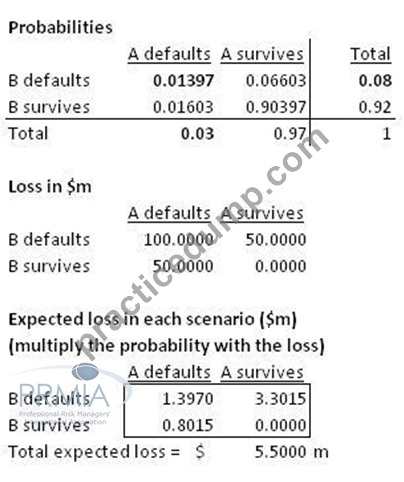
NEW QUESTION 156
Under the credit migration approach to assessing portfolio credit risk, which of the following are needed to generate a distribution of future portfolio values?
- A. A rating migration matrix
- B. All of the above
- C. The forward yield curve
- D. A specified risk horizon
Answer: B
Explanation:
Explanation
The credit migration approach to assessing portfolio credit risk involves obtaining a distribution of future portfolio values from the ratings migration matrix. First, the frequencies in the matrix are used as probabilities, and expected future values of the securities belonging to each rating category are calculated. These are then discounted to the present using the discount rate appropriate to the 'future' rating category. This gives us a forward distribution of the value of each security in the portfolio. These are then combined using the default correlations between the issuers. The default correlation between the issuers is often proxied using asset returns, and recognizing that default occurs when asset values fall below a certain threshold. A distribution for the future value of the portfolio is generated using simulation, and from this distribution the Credit VaR can be calculated.
Thus, we need the migration matrix, the risk horizon from which the present values need to be calculated, and the forward yield curve or the discount curve for each rating category for the risk horizon. Thus, Choice 'd' is the correct answer.
NEW QUESTION 157
When compared to a high severity low frequency risk, the operational risk capital requirement for a low severity high frequency risk is likely to be:
- A. Unaffected by differences in frequency or severity
- B. Zero
- C. Lower
- D. Higher
Answer: C
Explanation:
Explanation
High frequency and low severity risks, for example the risks of fraud losses for a credit card issuer, may have high expected losses, but low unexpected losses. In other words, we can generally expect these losses to stay within a small expected and known range. The capital requirement will be the worst case losses at a given confidence level less expected losses, and in such cases this can be expected to be low.
On the other hand, medium severity medium frequency risks, such as the risks of unexpected legal claims,
'fat-finger' trading errors, will have low expected losses but a high level of unexpected losses. Thus the capital requirement for such risks will be high.
It is also worthwhile mentioning high severity and low frequency risks - for example a rogue trader circumventing all controls and bringing the bank down, or a terrorist strike or natural disaster creating other losses - will probably have zero expected losses & high unexpected losses but only at very high levels of confidence. In other words, operational risk capital is unlikely to provide for such events and these would lie in the part of the tail that is not covered by most levels of confidence when calculating operational risk capital.
Note that risk capital is required for only unexpected losses as expected losses are to be borne by P&L reserves. Therefore the operational risk capital requirements for a low severity high frequency risk is likely to be low when compared to other risks that are lower frequency but higher severity.
Thus Choice 'c' is the correct answer.
NEW QUESTION 158
According to Basel II's definition of operational loss event types, losses due to acts by third parties intended to defraud, misappropriate property or circumvent the law are classified as:
- A. External fraud
- B. Execution delivery and system failure
- C. Internal fraud
- D. Third party fraud
Answer: A
Explanation:
Explanation
Choice 'c' is the correct answer. Refer to the detailed loss event type classification under Basel II (see Annex 9 of the accord). You should know the exact names of all loss event types, and examples of each.
NEW QUESTION 159
For a bank using the advanced measurement approach to measuring operational risk, which of the following brings the greatest 'model risk' to its estimates:
- A. Insufficient number of simulations when building the loss distribution
- B. Choice of incorrect parameters for loss severity distributions
- C. Aggregation risk, from selecting an incorrect value of estimated correlations between different operational risk estimates
- D. Choice of an incorrect distribution for loss event frequencies
Answer: C
Explanation:
Explanation
The greatest model risk when calculating operational risk capital comes from incorrect assumptions about correlations between different operational risks for which standalone risk calculations have been made.
Generally, the correlation can be expected to be positive, and would therefore vary between 0 and 1. These two values determine the 'bounds' between which the total operational risk capital would lie, and these bounds are generally quite far apart. Therefore the total value of the operational risk capital is very sensitive to the value chosen for the correlation, and this is the source of the biggest model risk under the AMA.
NEW QUESTION 160
Which of the following statements is correct?
- A. Market liquidity risk is idiosyncratic while funding liquidity risk is not
- B. Dynamic simulations of liquidity needs require an assumption of counterparty risk remaining constant
- C. Market liquidity risks present themselves in the form of higher bid offer spreads
- D. Funding liquidity risks present themselves in the form of an adverse market impact on prices from a trade
Answer: C
Explanation:
Explanation
Simulations of liquidity needs can be of various types: historical simulations, where the current positions are subjected to the kind of liquidity shocks experienced in the past; static simulations, where a static view of current positions, counterparty credit position, and the business is considered; and dynamic simulations where all factors are dynamically changed including counterparty credit standing, changes to the current portfolio and behavioural aspects of the business. Choice 'b' is incorrect as dynamic simulations require no such assumptions.
Liquidity risk is often thought of in terms of market liquidity risk and funding liquidity risk. Market liquidity risk relates to the the liquidity for a particular type of asset drying up. For example, during the 2007-2009 crisis a large number of corporate bonds and structured products became extremely illiquid. Market liquidity risk manifests itself in the form of higher bid offer spreads, higher pricde impact, and a reduction in the normal market size (ie, the 'normal' size of a trade for which a dealer quote is valid for). Therefore Choice 'd' is correct. Similarly, Choice 'a' is incorrect as adverse price impact results from market liquidity risk and not funding liquidity risk.
Market liquidity risk applies to the entire market and all its participants. It is not idiosyncratic. Therefore Choice 'c' is incorrect too. Funding liquidity risk on the other hand applies to an individual institution that is under liquidity stress in the sense of not being able to meet its obligations such as margin or collateral calls because of a lack of liquid assets. Thus it is funding liquidity that is idiosyncratic. Market liquidity risk often leads to funding liquidity risks materializing as firms are unable to get to the funds they were relying upon due to assets becoming illiquid.
NEW QUESTION 161
Which of the following best describes economic capital?
- A. Economic capital is a form of provision for market risk losses should adverse conditions arise
- B. Economic capital reflects the amount of capital required to maintain a firm's target credit rating
- C. Economic capital is the amount of regulatory capital that minimizes the cost of capital for firm
- D. Economic capital is the amount of regulatory capital mandated for financial institutions in the OECD countries
Answer: B
Explanation:
Explanation
Economic capital is often calculated with a view to maintaining the credit ratings for a firm. It is the capital available to absorb unexpected losses, and credit ratings are also based upon a certain probability of default.
Economic capital is often calculated at a level equal to the confidence required for the desired credit rating.
For example, if the probability of default for a AA rating is 0.02%, and the firm desires to hold an AA rating, then economic capital maintained at a confidence level of 99.98% would allow for such a rating. In this case, economic capital set at a 99.8% level can be thought of as the level of losses that would not be exceeded with a 99.8% probability, and would help get the firm its desired credit rating.
Choice 'c' is the correct answer. Economic capital does not target minimizing the cost of capital, nor is it a provision for losses arising from market risk. The concept of economic capital is unrelated to where an institution or firm is based, therefore Choice 'a' is incorrect as well.
NEW QUESTION 162
A bullet bond and an amortizing loan are issued at the same time with the same maturity and with the same principal. Which of these would have a greater credit exposure halfway through their life?
- A. They would have identical exposure half way through their lives
- B. Indeterminate with the given information
- C. The bullet bond
- D. The amortizing loan
Answer: C
Explanation:
Explanation
A bullet bond is a bond that pays coupons covering interest during the life of the bond and the principal at maturity. An amortizing loan pays the interest as well as a part of the principal with every payment. Therefore, the exposure of the amortizing loan continually reduces, and approaches zero towards the end of its life. The bullet bond will always have a higher exposure at any time during its life when compared to an equivalent amortizing loan. Hence Choice 'd' is the correct answer.
NEW QUESTION 163
Which of the following are valid objectives of a reverse stress test:
I. Ensure that a firm can survive for long enough after risks have materialized for it to either regain market confidence, restructure or be sold, or be closed down in an orderly manner, II. Discover the vulnerabilities of the current business plan, III. Better integrate business and capital planning, IV. Create a 'zero-failure' environment at the systemic level in the financial sector
- A. I and IV
- B. II and III
- C. I, II and III
- D. All of the above
Answer: C
Explanation:
Explanation
Statement I is true. According to the statement CP08/24: Stress and scenario testing (December 2008) issued by the FSA in the UK, an underlying objective of reverse stress tests is to ensure that a firm can survive long enough after risks have crystallized for one of the following to occur:
- the market decides that its lack of confidence is unfounded and recommences transacting with the firm;
- the firm down-sizes and re-structures its business;
- the firm is taken over, or its business is transferred in an orderly manner; or
- public authorities take the firm over, or wind down its business in an orderly manner.
Statement II and III are true. The same statement clarifies the intention of the reverse stress testing requirement, which is to encourage firms to: explore more fully the vulnerabilities of theirbusiness model (including 'tail risks'); make decisions that better integrate business and capital planning; and improve their contingency planning.
Statement IV is incorrect. Since the question is asking for the statement which is NOT an objective for reverse stress tests, Choice 'b' is the correct answer. The same statement clarifies that the introduction of a reverse-stress test requirement should not be interpreted as indicating that the FSA is pursuing a 'zero-failure' policy. In the FSA's view, such a policy is neither possible, nor desirable.
NEW QUESTION 164
Under the ISDA MA, which of the following terms best describes the netting applied upon the bankruptcy of a party?
- A. Multilateral netting
- B. Chapter 11
- C. Payment netting
- D. Closeout netting
Answer: D
Explanation:
Explanation
Netting is the ability to set just the net balances when amounts are both owed and due. Netting can take many forms. Payment netting is netting between counterparties that owe moneys to each other in the same currency under the same transaction (or master agreement). Closeout netting is when parties settle a net amount for the value of all outstanding transactions upon the occurrence of an event of default such as bankruptcy. Multiateral netting involves a third party that sets off exposures across counterparties that owe moneys to each other.
Closeout netting under the ISDA master agreement enables a party to terminate transactions early if an Event of Default or Termination Event occurs in respect of the other party. It involves the calculation and netting of the termination values of all transactions to produce a single amount payable between the parties. Closeout netting is therefore the correct answer.
NEW QUESTION 165
......
Pass PRMIA 8008 Exam Quickly With PracticeDump: https://testking.practicedump.com/8008-exam-questions.html