

[Mar-2026] Download Real Oracle 1z0-071 Exam Dumps Test Engine Exam Questions
New 1z0-071 exam dumps Use Updated Oracle Exam
Oracle 1z1-071 certification exam covers a broad range of topics related to SQL programming language, such as data definition language (DDL), data manipulation language (DML), and data control language (DCL). In addition, the exam also covers various topics related to SQL functions, such as single-row functions, group functions, and conversion functions. 1z0-071 exam also assesses the candidate's knowledge of schema objects, such as tables, views, indexes, and sequences.
NEW QUESTION # 141
View the exhibit and examine the structure of the PROMOTIONS table.
You have to generate a report that displays the promo name and start date for all promos that started after the last promo in the 'INTERNET' category.
Which query would give you the required output?
- A. SELECT promo_name, promo_begin_date FROM promotionsWHERE promo_begin_date > ALL (SELECT promo_begin_dateFROM promotionsWHERE promo_category = 'INTERNET');
- B. SELECT promo_name, promo_begin_date FROM promotionsWHERE promo_begin_date> ALL (SELECT MAX (promo_begin_date)FROM promotions) ANDpromo_category= 'INTERNET';
- C. SELECT promo_name, promo_begin_date FROM promotionsWHERE promo_begin_date IN (SELECT promo_begin_dateFROM promotionsWHERE promo_category= 'INTERNET');
- D. SELECT promo_name, promo_begin_date FROM promotionsWHERE promo_begin_date> ANY (SELECT promo_begin_dateFROM promotionsWHERE promo_category= 'INTERNET');
Answer: A
NEW QUESTION # 142
You want to display the date for the first Monday of the next month and issue the following command:
What is the outcome?
- A. It executes successfully but does not return the correct result.
- B. In generates an error because TO_CHARshould be replaced with TO_DATE.
- C. It executes successfully and returns the correct result.
- D. In generates an error because rrrrshould be replaced by rrin the format string.
- E. In generates an error because fmand double quotation marks should not be used in the format string.
Answer: C
NEW QUESTION # 143
SCOTT is a user in the database.
Evaluate the commands issued by the DBA:
Which statement is true regarding the execution of the above commands?
- A. Statement 1 would not execute because the WITH GRANT option is missing.
- B. Statement 1 would not execute because the IDENTIFIED BY <password> clause is missing.
- C. Statement 3 would not execute because role and system privileges cannot be granted together in a single GRANT statement.
- D. Statement 2 would not execute because system privileges and object privileges cannot be granted together in a single GRANT command.
Answer: D
NEW QUESTION # 144
Examine the structure of the PROGRAMStable:
Which two SQL statements would execute successfully?
SELECT NVL(ADD_MONTHS(END_DATE,1)SYSDATE)
- A. FROM programs;
- B. FROM programs;
SELECT NVL(MONTHS_BETWEEN(start_date,end_date),'Ongoing') - C. FROM programs;
SELECT NVL(TO_CHAR(MONTHS_BETWEEN(start-date,end_date)),'Ongoing') - D. FROM programs;
SELECT TO_DATE(NVL(SYSDATE-END_DATE,SYSDATE))
Answer: A,B
NEW QUESTION # 145
View the exhibit and examine the structures of the EMPLOYEES and DEPARTMENTS tables.
EMPLOYEES
NameNull?Type
---------------------- -------------
EMPLOYEE_IDNOT NULLNUMBER(6)
FIRST_NAMEVARCHAR2(20)
LAST_NAMENOT NULLVARCHAR2(25)
HIRE_DATENOT NULLDATE
JOB_IDNOT NULLVARCHAR2(10)
SALARYNUMBER(10,2)
COMMISSIONNUMBER(6,2)
MANAGER_IDNUMBER(6)
DEPARTMENT_IDNUMBER(4)
DEPARTMENTS
NameNull?Type
---------------------- -------------
DEPARTMENT_IDNOT NULLNUMBER(4)
DEPARTMENT_NAMENOT NULLVARCHAR2(30)
MANAGER_IDNUMBER(6)
LOCATION_IDNUMBER(4)
You want to update EMPLOYEES table as follows:
You issue the following command:
SQL> UPDATE employees
SET department_id
(SELECT department_id
FROM departments
WHERE location_id = 2100),
(salary, commission)
(SELECT 1.1*AVG(salary), 1.5*AVG(commission)
FROM employees, departments
WHERE departments.location_id IN(2900, 2700, 2100))
WHERE department_id IN
(SELECT department_id
FROM departments
WHERE location_id = 2900
OR location_id = 2700;
What is outcome?
- A. It generates an error because multiple columns (SALARY, COMMISSION) cannot be specified together in an UPDATE statement.
- B. It executes successfully and gives the desired update
- C. It generates an error because a subquery cannot have a join condition in a UPDATE statement.
- D. It executes successfully but does not give the desired update
Answer: D
NEW QUESTION # 146
The PRODUCTStable has the following structure.
Evaluate the following two SQL statements:
SQL>SELECT prod_id, NVL2 (prod_expiry_date, prod_expiry_date + 15, ' ') FROM products; SQL>SELECT prod_id, NVL (prod_expiry_date, prod_expiry_date + 15) FROM products; Which statement is true regarding the outcome?
- A. Both the statements execute and give different results
- B. Only the second SQL statement executes successfully
- C. Both the statements execute and give the same result
- D. Only the first SQL statement executes successfully
Answer: A
Explanation:
Explanation/Reference:
Explanation:
Using the NVL2 Function
The NVL2 function examines the first expression. If the first expression is not null, the NVL2 function returns the second expression. If the first expression is null, the third expression is returned.
Syntax
NVL2(expr1, expr2, expr3)
In the syntax:
Expr1 is the source value or expression that may contain a null
Expr2 is the value that is returned if expr1 is not null
Expr3 is the value that is returned if expr1 is null
NEW QUESTION # 147
Which statement is true about transactions?
- A. Each Data Definition Language (DDL) statement executed forms a single transaction.
- B. A combination of DDL and DML statements executed in a sequence ending with a COMMIT forms a single transaction.
- C. A set of Data Manipulation Language (DML) statements executed in a sequence ending with a SAVEPOINT forms a single transaction.
- D. A set of DDL statements executed in a sequence ending with a COMMIT forms a single transaction.
Answer: A
Explanation:
Explanation
References:
https://docs.oracle.com/database/121/CNCPT/transact.htm#CNCPT038
NEW QUESTION # 148
Examine the structure of the MEMBERS table: (Choose the best answer.)
Examine the SQL statement:
SQL > SELECT city, last_name LNAME FROM MEMBERS ORDER BY 1, LNAME DESC; What would be the result execution?
- A. It displays all cities in descending order, within which the last names are further sorted in descending order.
- B. It fails because a column number and a column alias cannot be used together in the ORDER BY clause.
- C. It displays all cities in ascending order, within which the last names are further sorted in descending order.
- D. It fails because a column alias cannot be used in the ORDER BY clause.
Answer: C
NEW QUESTION # 149
You execute this command:
Which two are true?
- A. A ROLLBACK statement can be used to retrieve the deleted data.
- B. It always retains the space used by the removed rows.
- C. It retains the integrity constraints defined on the table.
- D. It retains the indexes defined on the table.
- E. A FLASHBACK TABLE statement can be used to retrieve the deleted data.
- F. It drops any triggers defined on the table.
Answer: C,D
NEW QUESTION # 150
View the exhibit and examine the description of the EMPLOYEES table. (Choose two.)
You executed this SQL statement:
SELECT first_name, department_id, salary
FROM employees
ORDER BY department_id, first_name, salary desc;
Which two statements are true regarding the result? (Choose two.)
- A. The values in the SALARY column would be returned in descending order for all employees having the same value in the DEPARTMENT_ID and FIRST_NAME column.
- B. The values in the FIRST_NAME column would be returned in descending order for all employees having the same value in the DEPARTMENT_ID column.
- C. The values in all columns would be returned in descending order.
- D. The values in the SALARY column would be returned in descending order for all employees having the same value in the DEPARTMENT_ID column.
- E. The values in the FIRST_NAME column would be returned in ascending order for all employees having the same value in the DEPARTMENT_ID column.
Answer: A,E
NEW QUESTION # 151
Evaluate the following ALTER TABLE statement:
ALTER TABLE orders SET UNUSED order_date; Which statement is true?
- A. After executing the ALTER TABLE command, you can add a new column called ORDER_DATE to the ORDERS table.
- B. The DESCRIBE command would still display the ORDER_DATE column.
- C. ROLLBACK can be used to get back the ORDER_DATE column in the ORDERS table.
- D. The ORDER_DATE column should be empty for the ALTER TABLE command to execute successfully.
Answer: A
NEW QUESTION # 152
Examine the description of the employees table:
Examine these requirements:
1- Display the last name, date of hire and the number of years of service for each employee.
2. If the employee has been employed 5 or more years but less than 10, display -5+ years of service".
3. If the employee has been employed 10 or more years but less than 15, display "10+ years of service".
4. If the employee has been employed 15 or more years, display "15-*- years of service".
5. If none of these conditions matches, display "<5 years of service".
6. Sort the results by the hire_date column.
Which statement satisfies all the requirements?
- A.

- B.

- C.

- D.

Answer: D
NEW QUESTION # 153
Examine the description of the PRODCTS table which contains data:
Which two are true?
- A. The PROD ID column can be renamed.
- B. The PROD NAME column cannot have a DEFAULT clause added to it.
- C. The EXPIRY DATE column data type can be changed to TIME STAMP.
- D. The PROD_ ID column data type can be changed to VARCHAR2 (2).
- E. The EXPIRY DATE column cannot be dropped.
Answer: A,C
NEW QUESTION # 154
Which three statements are true? (Choose three.)
- A. Both USER_OBJECTSand CATviews provide the same information about all objects that are owned by the user.
- B. The USER_CONS_COLUMNSview should be queried to find the names of columns to which constraints apply.
- C. The data dictionary views consist of joins of dictionary base tables and user-defined tables.
- D. The data dictionary is created and maintained by the database administrator.
- E. Views with the same name but different prefixes, such as DBA, ALLand USER, reference the same base tables from the data dictionary.
- F. The usernames of all the users including database administrators are stored in the data dictionary.
Answer: B,E,F
Explanation:
Explanation/Reference:
References:
https://docs.oracle.com/cd/B10501_01/server.920/a96524/c05dicti.htm
NEW QUESTION # 155
Which statements are true? (Choose all that apply.)
- A. Views with the same name but different prefixes, such as DBA, ALL and USER, use the same base tables from the data dictionary
- B. The USER_CONS_COLUMNS view should be queried to find the names of the columns to which a constraint applies.
- C. The data dictionary views can consist of joins of dictionary base tables and user-defined tables.
- D. The usernames of all the users including the database administrators are stored in the data dictionary.
- E. Both USER_OBJECTS and CAT views provide the same information about all the objects that are owned by the user.
- F. The data dictionary is created and maintained by the database administrator.
Answer: A,B,D
NEW QUESTION # 156
Examine the structure proposed for the TRANSACTIONStable:
Which two statements are true regarding the storage of data in the above table structure? (Choose two.)
- A. The CUST_CREDIT_VALUEcolumn would allow storage of positive and negative integers.
- B. The TRANS_VALIDITYcolumn would allow storage of a time interval in days, hours, minutes, and seconds.
- C. The TRANS_DATEcolumn would allow storage of dates only in the dd-mon-yyyy format.
- D. The CUST_STATUScolumn would allow storage of data up to the maximum VARCHAR2size of 4,000 characters.
Answer: A,B
NEW QUESTION # 157
Examine this statement which executes successfully:
CREATE view emp80 AS
SELECT
FROM employees
WHERE department_ id = 80
WITH CHECK OPTION;
Which statement will violate the CHECK constraint?
- A. UPDATE emp80
SET department. 1d =80;
WHERE department_ id =90; - B. DELETE FROM emp80
WHERE department_ id = 90; - C. SELECT
FROM emp80
WHERE department_ id = 90; - D. SELECT
FROM emp80
WHERE department. id = 80;
Answer: B
Explanation:
In Oracle SQL, the WITH CHECK OPTION clause in a CREATE VIEW statement ensures that all data manipulation statements performed through the view must conform to the view's defining query.
* Option A: DELETE FROM emp80 WHERE department_id = 90;
* This will violate the CHECK constraint because the WHERE clause condition does not meet the view's restriction (department_id = 80). This statement attempts to delete rows that the view is not supposed to have access to (since it should only include rows where department_id is 80).
Options B, C, and D do not violate the CHECK constraint because:
* Option B: A SELECT statement does not modify data, so it does not violate the CHECK OPTION.
* Option C: Selecting rows with department_id = 80 is consistent with the view's definition.
* Option D: There is a syntax error, but assuming it meant to set department_id to 80 where it is currently 90, it still would not violate the CHECK constraint because the CHECK OPTION on a view does not prevent updates that do not change the rows to fall outside the view's filter. However, since department_id is supposed to be 80 as per the view definition, this update operation doesn't make logical sense, as there should be no rows with department_id = 90 to update.
NEW QUESTION # 158
Which two statements are true about sequences crated in a single instance Oracle database?
- A. When the MAXVALUE limit for a sequence is reached, it can be increased by using the ALTER SEQUENCE statement.
- B. The numbers generated by an explicitly defined sequence can only be used to insert data in one table.
- C. When the database instance shuts down abnormally, sequence numbers that have been cached but not used are available again when the instance is restarted.
- D. CURRVAL is used to refer to the most recent sequence number that has been generated for a particular sequence.
- E. DELETE <sequencename> would remove a sequence from the database.
Answer: A,D
NEW QUESTION # 159
Examine the data in the COLORS table:
Examine the data in the BRICKS table:
Which two queries return all the rows from COLORS?
- A. Both CASE and DECODE are functions.
- B. All conditions evaluated using CASE can also be evaluated using DECODE.
- C. DECODE is a function and CASE is not.
- D. AIl conditions evaluated using DECODE can also be evaluated using CASE.
- E. Neither CASE nor DECODE is a function.
- F. CASE is a function and DECODE is not.
Answer: B,C
NEW QUESTION # 160
View the exhibit and examine the structure of the CUSTOMERStable.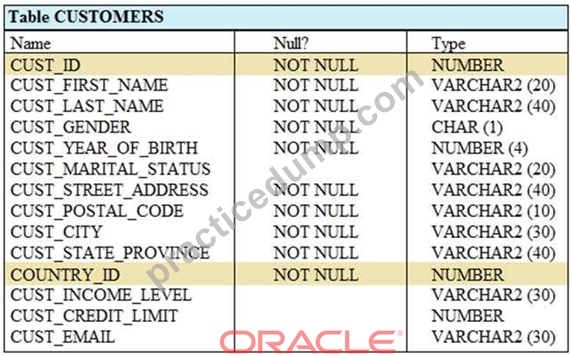
Which two tasks would require subqueries or joins to be executed in a single statement?
- A. finding the number of customers, in each city, whose marital status is 'married'.
- B. listing of customers who do not have a credit limit and were born before 1980
- C. listing of those customers, whose credit limit is the same as the credit limit of customers residing in the city
'Tokyo'. - D. finding the average credit limit of male customers residing in 'Tokyo'or 'Sydney'
- E. finding the number of customers, in each city, whose credit limit is more than the average credit limit of all the customers
Answer: C,E
NEW QUESTION # 161
Examine the data in the EMP table:
You execute this query:
SELECT deptno AS "Department", AVG(sal) AS AverageSalary, MAX(sal) AS "Max Salary" FROM emp WHERE sal >= 12000 GROUP BY "Department " ORDER BY AverageSalary; Why does an error occur?
- A. An alias name must not be used in a GROUP BY clause.
- B. An allas name must not contain space characters.
- C. An alias name must not be used in an ORDER BY clause.
- D. An alias name must always be specified in quotes.
Answer: A
Explanation:
C . True. The error occurs because the alias "Department" used in the GROUP BY clause is enclosed in double quotes, which makes it case-sensitive. However, the column deptno is not originally created with double quotes in the table definition, so you cannot refer to it with a case-sensitive alias in the GROUP BY clause. Oracle interprets "Department" as a string literal, not a column alias, in the GROUP BY clause.
A is incorrect because you can use an alias in an ORDER BY clause. B is incorrect because an alias can contain space characters if it is quoted. D is incorrect because an alias does not always have to be specified in quotes, only when it includes special characters or spaces or if it is case-sensitive.
NEW QUESTION # 162
Table EMPLOYEES contains columns including EMPLOYEE_ID, JOB_ID and SALARY.
Only the EMPLOYEES_ID column is indexed.
Rows exist for employees 100 and 200.
Examine this statement:
UPDATE employees
SET (job_id, salary) =
(SELECT job_id, salary
FROM employees
WHERE employee_id = 200)
WHERE employee id=100;
Which two statements are true?
- A. Employee 100 will have JOB_ID set to the same value as the JOB_ID of employee 200.
- B. Employees 100 and 200 will have the same JOB ID as before the update command.
- C. Employee 100 will have SALARY set to the same value as the SALARY of employee 200.
- D. Employee 200 will have SALARY set to the same value as the SALARY of employee 100.
- E. Employees 100 and 200 will have the same SALARY as before the update command.
- F. Employee 200 will have JOB_ID set to the same value as the JOB_ID of employee 100
Answer: A,C
Explanation:
The SQL UPDATE statement is used to modify existing records in a table. In the given statement, there is a subquery that selects the JOB_ID and SALARY of EMPLOYEE_ID 200 and sets these values to the corresponding columns of EMPLOYEE_ID 100.
* B. Employee 100 will have SALARY set to the same value as the SALARY of employee 200: This is true because the subquery selects the SALARY of employee 200 and the outer update statement sets this SALARY to employee 100.
* C. Employee 100 will have JOB_ID set to the same value as the JOB_ID of employee 200:
Similarly, the JOB_ID for employee 100 is updated to match the JOB_ID of employee 200 because of the subquery.
References:
* Oracle Database SQL Language Reference 12c, particularly the section on the UPDATE statement and subqueries.
NEW QUESTION # 163
......
Pass Your 1z0-071 Dumps as PDF Updated on 2026 With 325 Questions: https://testking.practicedump.com/1z0-071-exam-questions.html